Clients send me battery “breakthroughs” almost every week. Most are press releases about a cell nobody can buy. This one from Flinders University in Adelaide is worth a closer look — not because of the 60,000-cycle headline, but because of how the team got there.
What the team built
The cell pairs a zinc metal anode with an iodine cathode in a water-based electrolyte. The chemistry has obvious appeal for stationary storage: zinc is cheap and abundant, iodine stores a lot of charge for its weight (about 211 mAh/g in theory), and a water-based electrolyte does not burn the way the organic solvents in lithium-ion cells can.
The work was led by Associate Professor Zhongfan Jia and published in Angewandte Chemie International Edition under the title “Caging polyhalide anions in polycyclodextrin for long-lasting aqueous zinc-iodine batteries”.
The real achievement: taming the shuttle effect
The weak point of zinc-iodine cells has always been lifetime. During cycling, dissolved iodine species (polyiodides) drift away from the cathode, cross the separator and react where they should not. Capacity fades quickly. This is the shuttle effect, and it has kept the chemistry in laboratories for years.
The Flinders team used cyclodextrins — ring-shaped sugar molecules made from starch and already common in food and pharmaceuticals — and cross-linked them into a polymer. The rings work as molecular cages: they hold the iodine species and release them in a controlled way. What I like about this is that it is a materials answer, not an engineering workaround. It uses a cheap, well-understood ingredient to solve the chemistry's central weakness. Those are the ideas that tend to survive the move from the lab to a factory.
The numbers
The researchers report two operating regimes. The headline comes from the second one, which trades some capacity for lifetime:
| Regime | Charge time | Capacity | Cycles |
|---|---|---|---|
| Higher capacity | ≈ 7 minutes | 200 mAh/g | 8,000 |
| Longer life | ≈ 3 minutes | 150 mAh/g | 60,000+ |
The cell voltage is 1.3–1.4 V. For comparison, a LiFePO₄ cell sits at about 3.2 V nominal.
How I read it as a pack builder
- It is a lab result. The group is working with industry partners on a prototyping platform. There is no product, price or launch date.
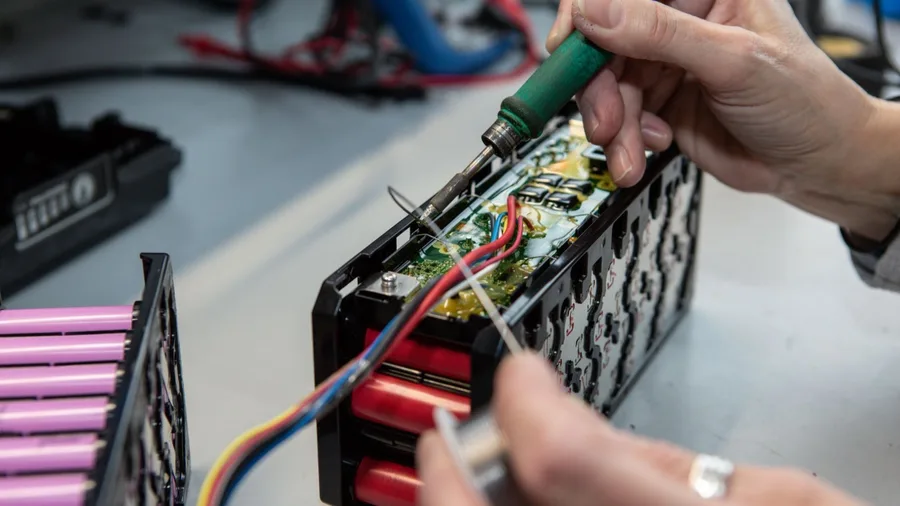
- Voltage is the hidden cost. At 1.3–1.4 V you need roughly two and a half times as many cells in series as with LiFePO₄ for the same pack voltage. That means more connections, more balancing channels in the BMS and more points of failure. In pack design, every extra series cell is a cost that never appears in a materials paper.
- No pack-level energy density yet. Capacity is quoted per gram of cathode material, not per kilogram of finished battery. Water-based chemistries are usually heavier and bulkier than lithium-ion for the same energy — acceptable in a container, not in a vehicle.
- 60,000 lab cycles is not a warranty. Fast cycling in a small cell is a stress test. It says little about calendar ageing, heat or years of real use. In the Gulf, heat is the test that matters.
Why it matters for storage and ESG
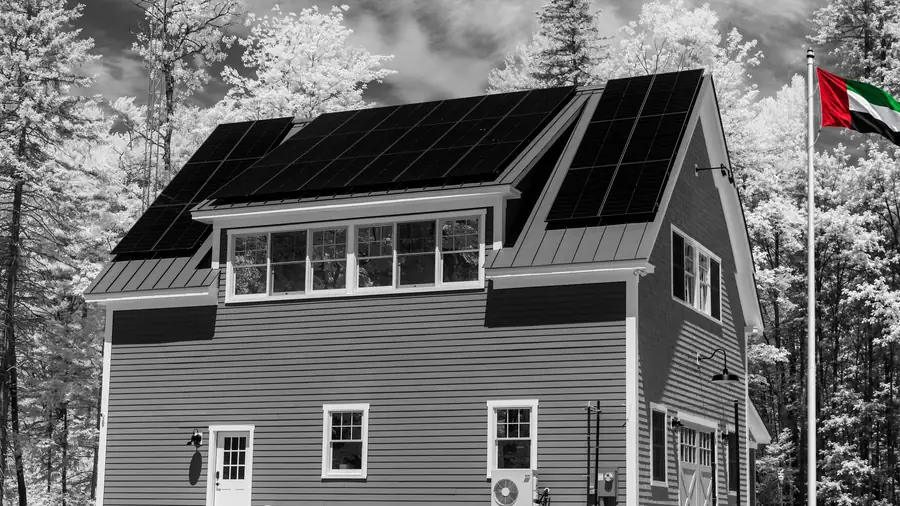
Grid and solar storage do not need the lightest battery. They need one that is safe, cheap per cycle and made from materials that are easy to source. Zinc-iodine ticks those boxes on paper: a non-flammable water-based electrolyte, abundant zinc (Australia holds an estimated 20–28% of world reserves, according to the researchers) and a cathode host made from a biodegradable sugar polymer. My view is that chemistries like this will not replace lithium-ion; they will take the part of the storage market where weight does not matter and fire safety and lifetime cost do — for example, storage inside buildings.
What to do today
For solar storage, UPS and e-mobility in the UAE, the practical choice in 2026 is still LiFePO₄: mature, safe and widely available. When cycle life is the main requirement — many fast charge cycles per day, wide temperatures — I recommend LTO (lithium titanate) cells, which are proven at tens of thousands of cycles today. We build packs on both at Thunderbolt in Dubai. Zinc-iodine is one to watch, and I will come back to it when the first commercial cells exist.
Frequently asked questions
Are zinc-iodine batteries available to buy in the UAE?
Not yet. The Flinders University cell is a laboratory prototype being developed with industry partners; there is no commercial product, price or launch date. For storage in the UAE today, LiFePO₄ and LTO packs are the proven options.
Is a zinc-iodine battery safer than lithium-ion?
Its water-based electrolyte does not burn the way the organic solvents in lithium-ion cells can, which is a real safety advantage for storage inside buildings. Pack-level safety still depends on design, BMS and installation.
Which battery lasts the most cycles for solar storage today?
Among proven, commercially available chemistries, lithium titanate (LTO) cells offer the longest cycle life — tens of thousands of cycles — while LiFePO₄ offers the best balance of cost, safety and life for most solar systems.
Can Thunderbolt build an LTO or LiFePO₄ storage battery in Dubai?
Yes. Thunderbolt designs, assembles and load-tests custom LiFePO₄ and LTO battery packs in Dubai, sized to the inverter and the load profile of the site.
Sources
- Angewandte Chemie International Edition — Jiang, Pei, Shi, Zhang, Chalker, Fraser-Miller, Coote, Jia, 13 August 2026 — original paper: “Caging polyhalide anions in polycyclodextrin for long-lasting aqueous zinc-iodine batteries”
- Flinders University release via chemeurope.com, 19 August 2026 — university announcement, both operating regimes, authors
- pv magazine, 27 August 2026 — 60,000 cycles at 150 mAh/g, 8,000 cycles at 200 mAh/g, 1.3–1.4 V
- ESS News, 27 August 2026 — large-scale storage focus, prototype status
- Notebookcheck, 20 August 2026 — prototype stage, capacity trade-off